
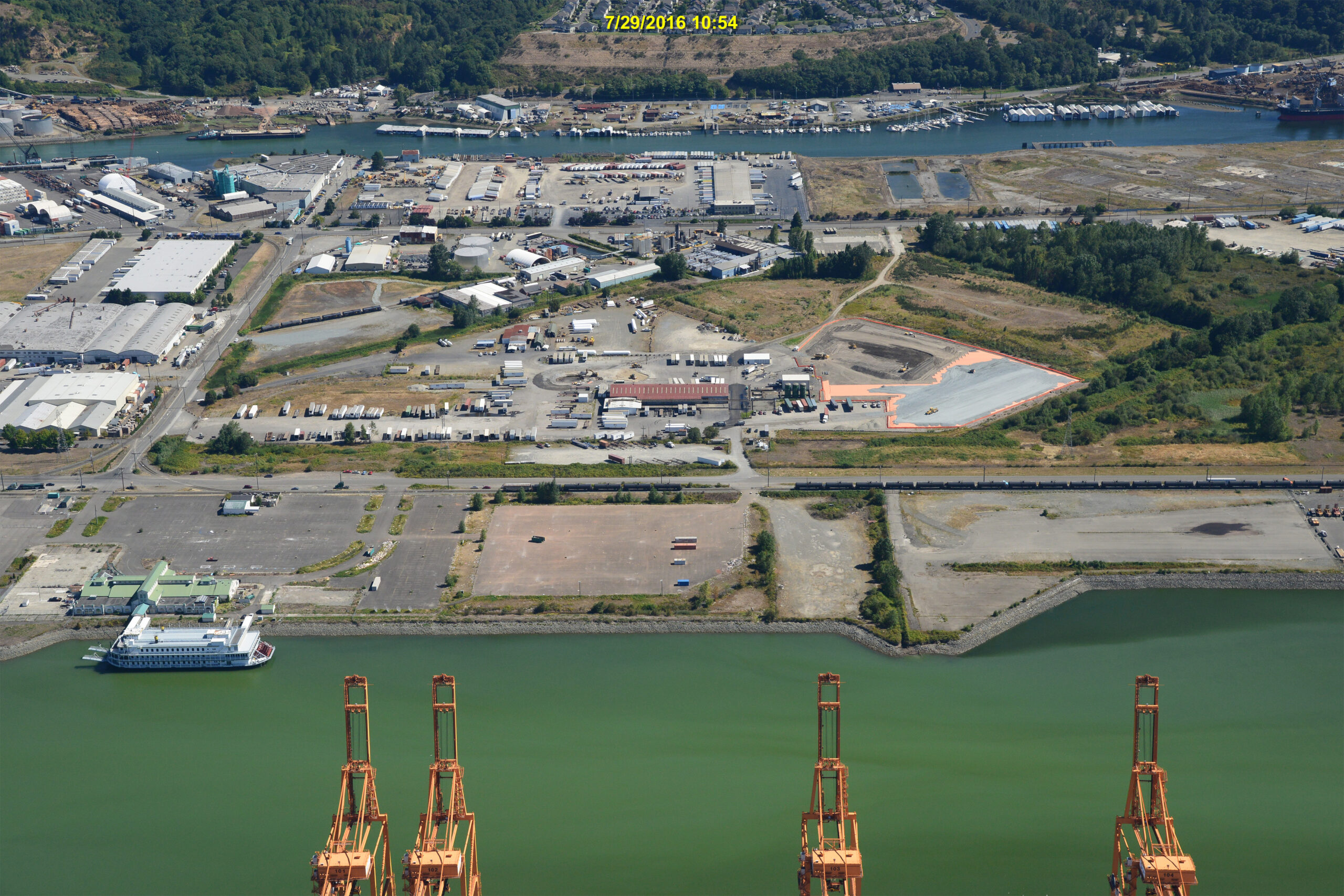
In the 1980s the Puyallup Tribe went toe-to-toe with local business owners, civic governments, the state, and even the federal government for the full reclamation and usage rights for lands granted by the Treaty of Medicine Creek in 1854 (later amended in 1873). After years of negotiation, the Puyallup Land Claims Settlement went into effect in 1990, granting the tribe $161 million in funds, property, and services.
A major sticking point in that settlement was the Blair Waterway. Tacoma business owners were adamant throughout negotiations that they did not want to recognize the Puyallup Tribe’s desire to construct and operate their own shipping business on the Port of Tacoma. Eventually, through great determination and legal wrangling, the Tribe were granted rights to property on the waterway, as well as a $51 million fund to dredge the channel for the creation of a deep water port. That was 25 years ago.
The actual dredging of the Blair Waterway is only expected to get underway this year, in part due to the prolonged process to reach a ‘Memorandum of Understanding’ with the port. Reached in 2013, that process allowed the tribe to acquire land that could allow for actual, functional construction of port services (something the initial land agreement didn’t do). It also created a framework for an agreement on transportation access, both for port-owned rail lines and city/state owned roadways to access a new Puyallup Tribe Terminal facility.
Earlier this year, the tribe officially announced their partnership with the Northwest Seaport Alliance (NWSA). That partnership would put the Tribe in position to construct and maintain their own Port of Tacoma facility, while the NWSA (which operates much of the Port’s current shipping infrastructure) would manage the day-to-day operations of the new Port. As a result the tribe and the NWSA would share revenue from the facility in a 50/50 split.
The enterprise comes with a $200 million dollar price tag for the tribe. A seemingly steep bill considering they’ll be splitting the returns, but small potatoes considering the NWSA handles a reported $76 billion in annual trade, between their operations in Tacoma and Seattle. Even a small piece of that would generate a significant return on investment.
Despite likely being years from completion, the plan is already garnering rave reviews.
“A 50/50 agreement between the tribe and the alliance is a handshake toward a brighter economic future,” wrote the Seattle Times editorial board in response to the announcement. “As the first tribally owned deep-water port in the country, it sets an example that can serve to inspire the way other governments, tribes and businesses collaborate. And it marks the latest chapter in a comeback for a tribe that, in 1950, had only about 10 families left that still owned U.S. government-assigned allotments in and around the path of the Puyallup River.”
The project has even received its first accolades, announced earlier this month, winning a Vision 2050 award from the Puget Sound Regional Council.
“The Puyallup Tribal Terminal aligns with VISION 2050 priorities by expanding the region’s trade capacity, reducing environmental impacts through low-carbon infrastructure and advancing equity through Tribal-led development,” wrote PSRC Executive Director Josh Brown in a statement announcing the award.
The project is expected to reach completion by 2030.